

Student vs. Professional Flutes: What You Need to Know
Choosing the right flute is a pivotal step in any flutist’s journey. Whether you’re just starting or considering an upgrade, understanding the key differences between student and professional flutes is essential. In this guide, we’ll break down the unique features, benefits, and considerations for each type of flute to help you make the best choice.
What is a Student Flute?
Student flutes are specifically designed for beginners and early-stage learners. These flutes are built with affordability, durability, and ease of use in mind, making them ideal for those just starting their musical journey.
Key Characteristics of a Student Flute
- Materials: Typically made of nickel, which is then silver-plated for a shiny appearance and added durability. Read More about what the concert flute is made of here.
- Key Design: Most student flutes feature an offset G key, which is more ergonomic for smaller hands.
- Foot Joint: Student flutes generally have a C foot joint, which reduces the weight of the flute and makes it easier to manage.
- Affordability: With their budget-friendly price points, student flutes are accessible for most beginners.
Why Choose a Student Flute?
Student flutes are mass-produced in factories to keep costs low. They’re excellent for developing foundational skills and learning basic techniques. While they may not offer the advanced features or tonal range of higher-end models, they’re reliable instruments for getting started.
What is a Professional Flute?
Professional flutes are crafted for experienced players who require superior tone, responsiveness, and craftsmanship. These flutes are often handmade or hand-finished to ensure the highest quality.
Key Characteristics of a Professional Flute
- Premium Materials: Professional flutes use sterling silver, gold, or platinum, which enhance tone quality and projection.
- Advanced Craftsmanship: Many professional flutes are handmade, ensuring precision and attention to detail.
- Key Design Options: Available in both offset G and inline G configurations to suit player preferences.
- Foot Joint: Typically features a B foot joint, which extends the instrument’s range to lower notes.
- Customization: Professional flutes often include advanced features like engraved keys, custom headjoints, and more.
Who Should Choose a Professional Flute?
Professional flutes are ideal for advanced players, performers, or serious enthusiasts. They offer a richer, more nuanced tone and allow for greater artistic expression, making them a worthwhile investment for those who have mastered the basics.
Flute-Like Objects (FLOs): What to Avoid
Not all flutes on the market are of good quality. Some instruments, known as Flute-Like Objects (FLOs), are poorly made and usually are a source of frustration.
Common Issues with FLOs
- Misaligned Keys: Keys that don’t seal properly, making it impossible to play in tune.
- Inferior Materials: Poor-quality metals that negatively impact tone and durability.
- Design Flaws: Irregular lip plates that make sound production difficult. Sometimes they are missing keys!
Just Want a Budget Flute?
While low budget flutes may be tempting due to their low prices, it’s a bit tricky to find one that’s actually put together right.
I’ve been testing these types of flutes for the past few years, and I’ve had some success!
Check out this exact flute that I’ve found and am using it as my travel flute. *Make sure you get the open-hole, intermediate version. If you have a hundred bucks and want to try it.. it has actually been pretty good. I stick it in my backpack when I’m off on a global adventure.
If it breaks, what will I do?
Due to the materials used to make this flute, it might not be fixable by a technician. Soooo, no problem. It was low cost, and I’ll just order a new one.
Read more about what a technician does here.
Key Differences Between Student and Professional Flutes
Here’s a side-by-side comparison of student and professional flutes:
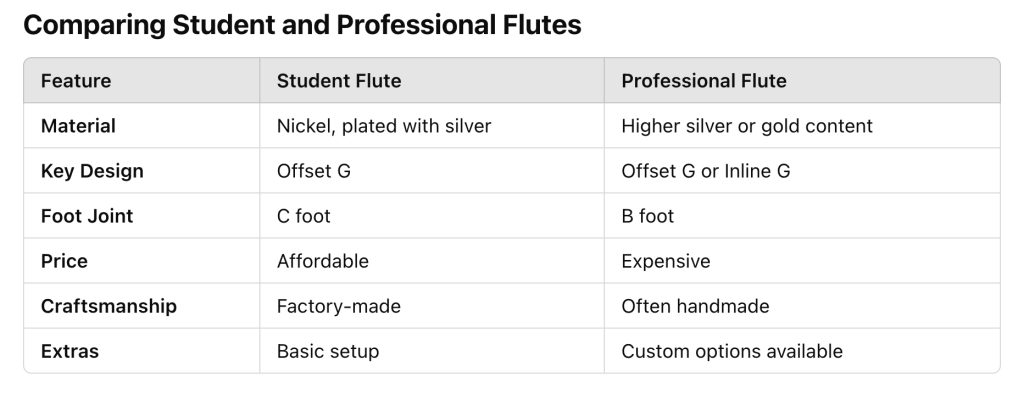
Watch this video for an in-depth explanation of flute qualities and levels:
How Materials Affect Tone and Durability
The materials used in a flute play a significant role in its tone and durability… but only if you know how to play it.
A flute can be made of the highest quality gold, and if the player doesn’t have technical skills to make it ‘go’, .. well then… keep learning. 🙂
Nickel and Silver
Student flutes are typically made of nickel with a silver-plated finish. While this combination is durable and budget-friendly, it produces a brighter, less complex tone.
I find that quality student flutes are fine for people with skin allergies. The lower quality ones (commonly found on Amazon for less than $200) are common for skin problem amongst those who already have sensitivity to certain metals (like nickel).
Sterling Silver
Found in professional flutes, sterling silver enhances resonance, brightness, and projection. It’s a preferred choice for flutists seeking a resonant sound that stands out.
Gold and Platinum
Some professional flutes incorporate gold or platinum, offering unique tonal characteristics. Gold provides a mellow, luxurious tone, while platinum adds weight and projection.
Gold = warm
Silver = bright
FAQs: Common Questions About Flutes
- Is it worth buying a used professional flute?
Yes, a well-maintained used professional flute can save money while still offering excellent performance. Be sure to purchase it from a super super high level rep. I have the best one in the world.. want me to hook you up? email me [email protected] - What’s the lifespan of a student flute?
With proper care, a student flute can last for many, many years. However, as skills advance, players may find the instrument limiting. .. and like all instruments, they don’t stay in tip-top shape unless you make sure they are cared for properly and see a technician regularly. - Should I upgrade parts of my flute?
Absolutely! Upgrading the headjoint is a cost-effective way to improve tone and playability without purchasing a new flute. ..but only if it’s a high quality flute to start with. Putting a gold headjoint on a $75 flute won’t help much. Also, headjoints fit different bodies uniquely. (meaning, they are not one-size-fits-all) - How do I know when to upgrade?
If you feel your current flute is holding you back—such as loads of squeaking when trying to play louder (assuming you have the technique to do this well)—it may be time to upgrade. More on this in the Learn Flute Online modules.
Tips for Choosing the Right Flute
- Set a Budget: Decide on a price range before shopping.
- Research Brands: Stick to trusted manufacturers like Yamaha, Gemeinhardt, or Pearl.
- Seek Recommendations: Consult a teacher or experienced flutist for advice.
- Test Play: Always try flutes in person to ensure they meet your expectations.
Watch the Video: Flute Qualities and Levels
For a deeper understanding of flute qualities and levels, check out this video https://youtu.be/g1-pVOjlsI8?si=d83R35mua6cys_JE:
Conclusion
Choosing between a student and professional flute is a personal decision that depends on your skill level, goals, and budget. By understanding the key differences and what to look for, you’ll be better equipped to select the perfect flute for your musical journey.
I do suggest you go for a quality flute even as a starter if possible. If you do go searching for a new flute, it will be best to be armed with the knowledge you find on this page.
It can be a bit daunting when starting the search, but know that I will point you in the right direction. In fact, if you’re on my email list, you’ll have access to what you’re looking for.
Just knowing the difference between student vs. professional flutes is a great bank to draw from.