
Why Your B Flat Fingering Choice Matters
If you’re learning to play the flute, there’s a good chance you’ve already run into a bit of a surprise: there’s more than one way to play B flat. Maybe you’ve not heard of this yet. No worries, I’m going to show you why choosing the right one at the right time can make a big difference in your technique.
In this article, we’ll walk through the two most important flute B flat fingerings: the traditional B flat fingering and the thumb B flat or B flat thumb.. (also could be known as the Briccialdi key). Both of these fingerings are useful, and learning how and when to use them is one of the smartest things you can do as a flutist.
You’ll learn what each fingering looks like, why it works, when to use it, and how to avoid the most common mistakes. I’ll also share an example from my own playing and help you feel completely confident in this part of your flute journey.. So be sure to watch the video on this page as well.
Whether you’re brand new to the flute or you’ve been playing for a while and still wonder which B flat fingering to use, this guide will give you the clarity you need.
Watch this quick video where I demonstrate the traditional B flat fingering and the B flat thumb fingering, including a behind, close-up view.
What Is the Traditional B Flat Fingering on Flute?
The traditional flute B flat fingering is the one most flute players should learn first. It’s reliable, it works in most situations, and it’s important for developing strong fundamentals especially for balancing the flute.
Here’s how to play traditional B flat on the concert flute:
- Left-hand index finger presses the first key (often called the C key)
- Left-hand thumb presses the long thumb key (this is the B natural key)
- Right-hand index finger presses the F key
Right-hand pinky presses the D# lever (also called the Eb key)
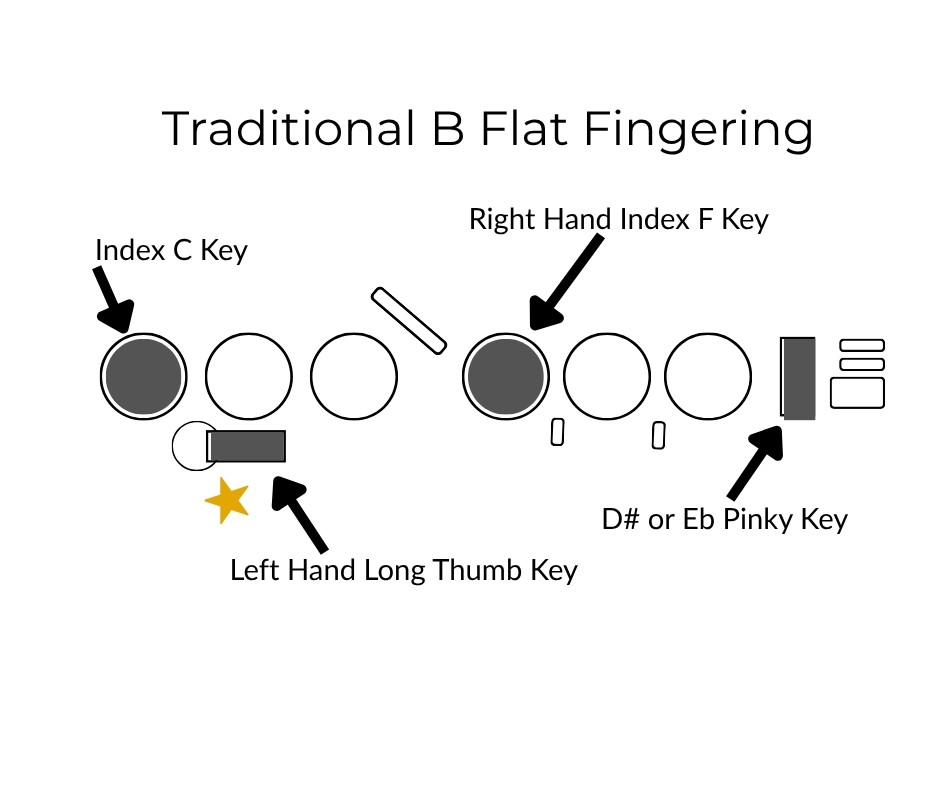
This flute B flat fingering combines both hands and aids with good balance and coordination. There are loads of other reasons to learn this fingering first, but I like to point out good balance as one of the main reasons.
Also, if you’ve learned from me, you’ll find that this fingering feels natural and easy within the progression of the lessons I have set for you inside Learn Flute Online. (join us inside the members area if you haven’t yet!)
In the early stages of flute playing, this flute B flat fingering helps you stabilize the instrument, develop good hand position, and separate the B flat fingering from B natural. That separation is key for learning to read and hear notes accurately.
*Tip: play B flat, then B natural, then B flat again over and over by lifting the first index finger on the right hand and then pressing it again (while leaving the other fingers on for this fingering), listening to the difference in the pitches. They are different.
One fun detail I like to show students is how pressing the F key causes the little key below the C key to close. This is what makes the pitch change from B natural to B flat – it’s a half step lower. This can help you understand how the flute’s keywork is connected. Seeing it in action makes the mechanism easier to remember.
*B flat is a half step lower in pitch than the B natural.
This fingering is used for basically all B flats (until we learn how to use the other one.. Then we get to decide which could be more efficient), especially when B flat appears alone or in keys like F major. It also helps build awareness of right-hand positioning.
The traditional flute B flat fingering lays the groundwork for strong technique, so go ahead and use it with confidence. As you use this traditional flute B flat fingering, you’ll find it’s literally everywhere in music.
Section 2: What Is the B Flat Thumb (Thumb B Flat) and When to Use It
The B flat thumb (thumb B flat), also known as the Briccialdi key (or the round thumb key) is another way to play B flat on the flute. This version uses a round key operated by your left-hand thumb to produce the same pitch but it changes how the key mechanism functions.
Basically, your left hand thumb presses the round key instead of the long key, and we don’t use the right hand index finger like we did in the traditional flute B flat fingering.
Here’s how to play the thumb B flat:
- Left-hand index finger on the first key (C key)
- Left-hand thumb on the round B flat key (not the long B key)
- Right-hand pinky on the D# lever (Eb key)
- No right-hand index finger is used
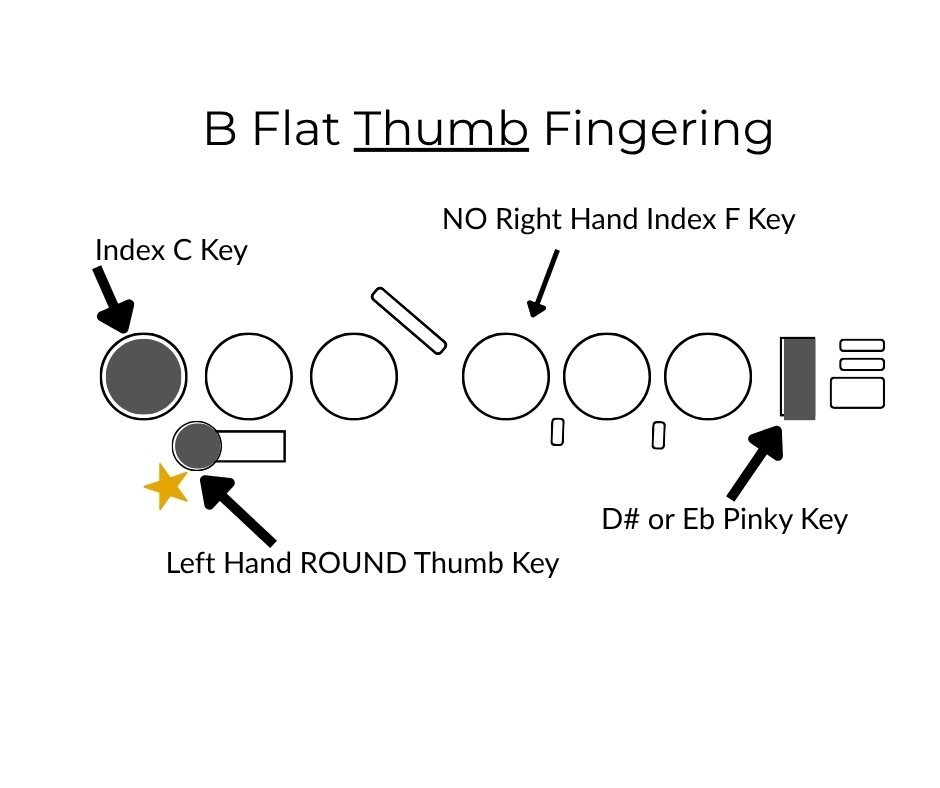
The thumb B flat fingering can feel like a shortcut if you learn to use it right, and in many cases, it is. Once a student has developed stable hand position and clear awareness of B flat versus B natural, this fingering becomes an extremely helpful tool. (it’s a cool invention – thank you Mr. Briccialdi and Mr. Boehm!)
It’s especially useful in fast passages where B flat is surrounded by notes that don’t have quite as convenient reach to play the traditional flute B flat fingering. It eliminates the need to move your right-hand index finger on and off and makes quick runs smoother and more efficient.
I recommend students learn this fingering only after they’ve spent time using the traditional version (like 2-4 years if possible). If you learn it too early, it’s easy to confuse B flat and B natural, which can lead to problems you don’t know you’re even creating. In the video I placed on this page, you’ll hear the buzzing bees example in in group playing.. Have you heard this before? It’s a common sound in early flute groups when *someone* is using the wrong B or B flat fingering and everyone sounds super off tune.
One of my favorite examples of when to use thumb B flat is in fast scales or runs. Let’s say you’re working on a B flat major scale (after you’ve already been using the traditional flute B flat fingering for a couple of years consistently), thumb B flat will feel much more natural and clean. You can also try it in technical pieces or sections that stay in flat keys.
Tip: If there are B naturals mixed in, just go ahead and stick with the traditional fingering so you don’t have to bother switching the thumb back and forth. *Of course, there are occasions that call for both depending on what is surrounding the notes.
Using the B flat thumb doesn’t mean abandoning the traditional flute B flat fingering. In fact, great flute players learn to switch between the two depending on the musical situation. That’s something I teach step by step inside the Learn Flute Online modules, so you always know which choice is best for the music in front of you.
Common Mistakes to Avoid with Flute B Flat Fingerings
As helpful as B flat thumb can be, it also opens the door to one of the most common flute fingering mistakes: forgetting to turn it off when switching to a B natural. (oops!)
This error is especially easy to make for players who learn to use the thumb B flat too early. Without a very strong understanding of the difference between B flat and B natural, it’s easy to leave the thumb key on by accident. The result? You’ll play a B flat when you meant to play a B natural.
And if you’re playing in a group, that tiny mistake can stand out in a big way. I like to call it the “buzzing bee” effect.. it’s that moment in a beginner band when one or two flutists accidentally plays with the wrong thumb on, and suddenly the whole section sounds like a swarm of bees. It’s not a pretty sound.
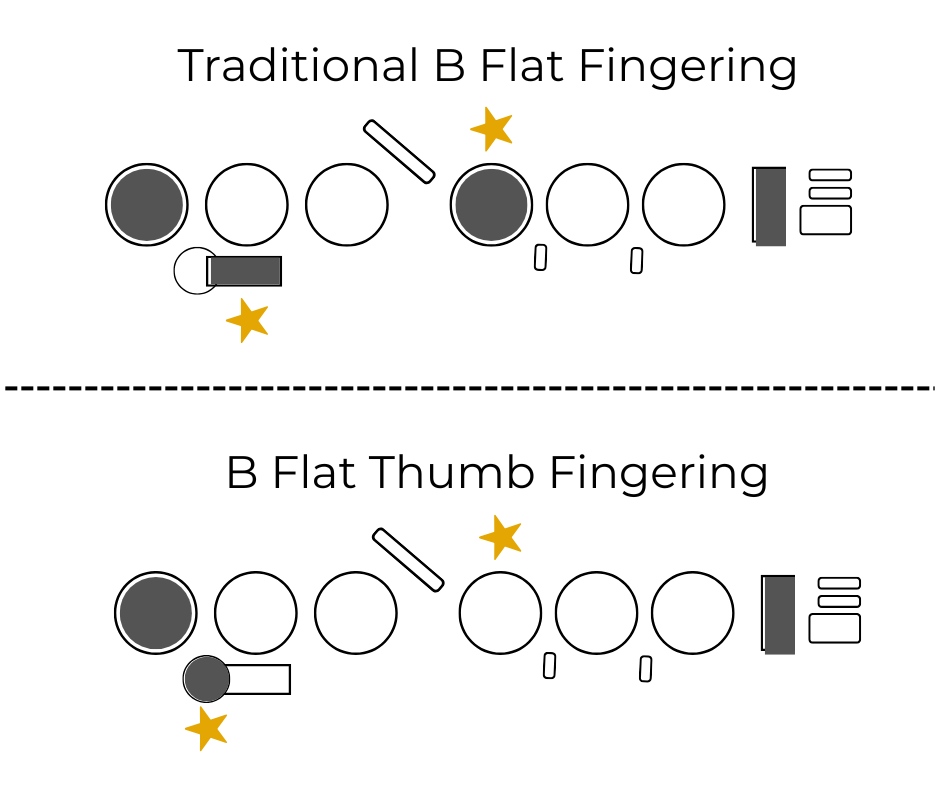
Another mistake I often see is using the B flat thumb (thumb B flat) in a key where it doesn’t belong enough to warrant using it. For example, if your music is in G major or D major, both sharp keys, you’ll likely need to switch between B natural and B flat (which will most likely be called an A sharp in this key). If the thumb B flat is locked down for the whole passage, those B naturals will become wrong notes. (oops again!)
That’s why I like to teach my students to master the traditional flute B flat fingering first. It builds good habits, strengthens balance, and ensures you know exactly what note you’re playing. Then, when you add thumb B flat later on, it becomes a helpful tool rather than a source of confusion.
Inside Learn Flute Online, I walk you through exactly when to use each fingering and how to avoid these common traps. This way, you can feel confident knowing your fingers are doing the right thing, and your tone will reflect your competency. (yay!)
When to Switch Fingerings and How to Make It Seamless
Inside the Learn Flute Online modules (intermediated and advanced especially), I’ll show you exactly how and where to use each B flat fingering based on what’s happening in the music. For now, I have a quick tip that can help you make smoother choices starting today.
If you’re playing in a key with a lot of B flats, like B flat major or E flat major, the thumb B flat is often a clean option. It allows you to move quickly through scales, arpeggios, and fast runs without shifting your right-hand index finger on and off.
But if your music includes both B flats and B naturals, especially in sharp keys like D or G major, it’s safer to use the traditional flute B flat fingering. This gives you full control and helps prevent wrong notes from sneaking in when the thumb key is mistakenly left on.
Once you’re comfortable using both options, the real fun begins. You’ll be able to choose the fingering that makes your music feel smooth and natural. One great example is in Humoresque by Dvořák. There’s a quick little ornamented passage that flows much better when the thumb B flat is used correctly. I demonstrate this inside the video so you can hear and see the difference.
Switching to this flute fingering may feel tricky at first, but with a little practice, it becomes second nature. The key is to stay aware of your key signature, know which notes are coming next, and choose the fingering that gives you the most fluid and musical result.
🎓 If you want to know which fingering to use in every situation, this is exactly the kind of thing I walk you through step by step inside the Learn Flute Online levels. You’ll never have to guess.
Mastering Your B Flat Fingerings with Confidence
Understanding the difference between flute B flat fingerings is a small step that makes a big impact. The traditional B flat helps build balance, accuracy, and clarity from the very beginning. The thumb B flat (or B flat thumb) opens the door to speed, fluency, and easier technique when you’re ready for more.
Both fingerings have a place in your flute journey. The more you understand when and how to use them, the more confident you’ll feel in your playing.
If you’re still unsure which fingering to use in a certain piece or you want to learn exactly how to practice them the right way, I can help. Inside the Learn Flute Online members area, I walk you through every detail including when to use which fingering, how to switch between them with ease, and how to develop habits that support your best sound.
Whether you’re just getting started or looking to refine your technique, there’s a place for you inside the Gold, Intermediate, or Advanced Levels of Learn Flute Online.
👉 Ready to move forward with complete guidance and a clear path?
Start here (on this page – find the Get Started button): https://mainstaging.learnfluteonline.com
And I’d love to hear from you in the comments: which B flat fingering do you use most often? Or are you just starting to learn the difference?
Leave a comment or share your thoughts. I read every single one.
Keep practicing, keep growing, and enjoy every note you play.
Rebecca