

Common Flute Habits That Hold Players Back (And How to Fix Them)
If you’ve ever wondered why your flute tone doesn’t quite sparkle or why progress feels slower than it should, you’re not alone. Many flute players, especially those who are self-taught or learning through bits and pieces online, develop common flute habits early on that quietly work against them.
These flute habits aren’t always obvious. In fact, some may even feel helpful at first. But over time, they can hold you back from sounding as beautiful and expressive as you truly want to be.
The good news is that every single one of these bad flute habits can be gently unlearned and replaced with better, easier techniques. These changes will support a more confident, relaxed sound and help you enjoy your practice time even more.
As a flute educator who has worked with thousands of adult learners over the years, I have seen how easy it is to fall into these traps without realizing it. And I have also seen how quickly things can improve once you know what to change.
In this article, you’ll discover:
- Common flute habits (flute playing habits) that often develop without guidance
- Why these habits feel helpful at first but cause long-term frustration
- Clear, step-by-step suggestions for what to do instead
- A printable chart that will help you remember the healthy flute habits
- Additional resources to help you move forward with joy and confidence
If your goal is to improve your flute tone, sound beautiful, stay motivated, and feel proud of the music you create, you are in exactly the right place.
Learning to play the flute well is not about being perfect. It is about building the right foundation, one simple skill at a time. And knowing which flute habits to avoid or fix is one of the most powerful ways to make real progress and enjoy your journey more fully.
So let’s dig in together. By the end of this article, you’ll be equipped with the insight and encouragement you need to move forward with clarity and confidence.
Why Habits Matter More Than You Think
When it comes to learning the flute, it is easy to focus on the big goals. We want to play flute beautifully, master a favorite song, or impress ourselves with how far we have come. But what actually moves us forward the most are the small, daily flute habits we build. These are the choices we make, often without thinking, that shape how we hold the flute, how we breathe, and how we move our fingers.
If you are practicing flute regularly and still not hearing the tone or ease you hoped for, it might not be a lack of effort. Instead, it could be one or two common flute habits that are quietly working against your progress.
This is especially true for adult flute learners who are often balancing busy lives. You might not have hours a day to dedicate to flute. That is why it is so important to make sure the time you do spend is setting you up for success.
By identifying and adjusting these flute habits, you are creating a smoother path to improving your flute tone (sounding better) and feeling more confident. Think of it as tuning up the way you learn, so that each minute of practice brings you closer to your goals.
The good news? These adjustments are usually small. And once you notice them, they are easy to improve.
In the following sections, I will walk you through five common flute-playing habits to fix that I see again and again. I will explain why each one makes things harder than they need to be and give you a simple action to try instead.
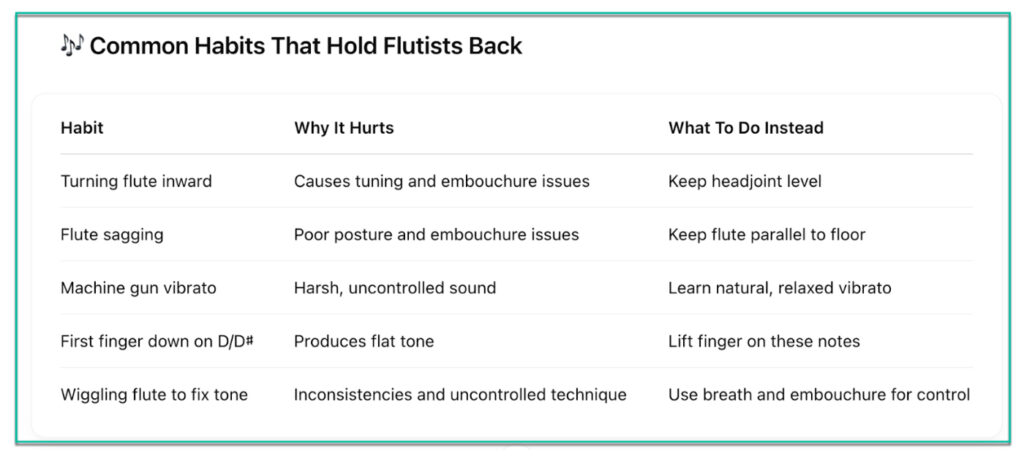
To help you keep things clear, I have also included a handy visual chart that summarizes the habits that hold flute players back, their effects, and the healthy fix.
Let’s begin with one of the most common and sneaky flute habits of all: turning the instrument inward.
Flute Habit #1: Turning the Flute Inward
Many flute players, especially in the early stages, unknowingly rotate their flute inward toward their face. It can feel like an easy fix when struggling to get a clearer tone. Some describe it as “tucking in” the flute or “aiming it closer.” But this quick solution often leads to more problems than it solves.
Why It Happens
When players are unsure how to shape their embouchure or aim their air stream, they sometimes tilt the headjoint to get an immediate improvement in tone on a few notes. It feels like a shortcut, and in the moment, it might even work. But the issue is that this change only benefits a small portion of the range, while causing imbalance across the rest.
This inward angle can make your lower notes sound muddy, your middle register pinched, and your high notes thin or screechy. It also interferes with your ability to use proper breath support and lip flexibility. Over time, this becomes one of those bad flute habits that quietly limits your progress and creates frustration with your flute tone.
What to Do Instead
The solution lies in maintaining a balanced, level headjoint. The flute should sit comfortably against your bottom lip, parallel to the floor, not tilted in toward your teeth or chin. Keeping the headjoint level allows your airstream to be directed across the embouchure hole, not straight down into it.
You’ll want to practice in front of a mirror regularly to check your positioning. Imagine the flute gently resting under your lip while you aim your air just above the far edge of the tone hole. This simple correction opens the door to more consistent tone across all registers.
Over time, your tone will feel more even, and you will be able to shift registers with greater ease. This is one of the first posture flute habits we address inside the Learn Flute Online member area, and the difference it makes can be immediate.
🎧 Want help with setting up your flute correctly from the start?
Watch this helpful tutorial on headjoint alignment:
How to Line Up Your Flute
Flute Habit #2: Letting the Flute Sag
This is one of the most common posture issues I see in flute players of all ages. The flute slowly starts to point downward, especially when trying to relax the arms or shoulders. It might not seem like a big deal at first, but over time, a sagging flute creates big problems in your flute tone (sound) and body alignment.
Why It Happens
Many newer (beginners especially) flute players want to feel more relaxed, so they drop their arms slightly or adjust their head downward to see the music stand better. Others may unknowingly accommodate physical tension or fatigue by letting the instrument tilt toward the ground.
When the flute points downward, the head, neck, and shoulders start to compensate. This can cause stiffness, discomfort, and even long-term pain. More importantly, it pulls your embouchure out of alignment and makes it harder to control the tone across octaves.
What to Do Instead
The ideal playing position is one where the flute remains parallel to the floor, extending slightly forward and to the right side of your body. This allows the airstream to be consistent and centered over the embouchure hole, which results in a clear, ringing flute tone.
To help with this, try practicing in front of a mirror. Look at your posture from the side and double-check that the flute isn’t pointing toward the ground. A small lift in your right elbow and a gentle reach forward can make a big difference in your flute playing technique.
Also, make sure your music stand is at eye level. If you’re looking down to read, you’ll naturally start to let the flute sag. Lifting your stand and standing or sitting tall will encourage better form and easier breathing.
Need more ideas for building healthy flute habits as a beginner?
Check out this supportive article:
👉 Four Things That Help a Beginner Flute Player
Flute Habit #3: Using Uncontrolled Vibrato
Have you ever heard a flute player whose tone sounds jumpy or overly wobbly, almost like a machine gun, bleating sheep or a startled goat? This fast, jittery sound is often mistaken for vibrato, but in reality, it’s a habit known among flutists as “uncontrolled vibrato.”
Why It Hurts Your Playing
True flute vibrato is a controlled, natural variation in tone that adds expression and warmth. It should sound gentle and musical, not shaky and nervous sounding.
Uncontrolled vibrato, on the other hand, is created quivering the air (from inside the throat) without intension or coordination. Instead of enhancing the sound, it creates a nervous, choppy tone that can make even the most beautiful music sound anxious or strained. This kind of vibrato often develops from tension, or from trying to imitate vibrato without learning the correct technique.
It can be discouraging because the player might think they’re adding emotion and style, but what listeners hear is an unnatural wobble that distracts from the melody.
What to Do Instead
The good news is that a smooth, expressive flute vibrato can be learned, and it feels wonderful once it’s in place.
Start by focusing on relaxed, even airflow. If you’re just beginning to add vibrato to your flute playing, slow it down and work on gentle pulses with the breath, rather than with the jaw or lips. One great exercise is to pulse every few beats, then gradually increase the number of pulses per beat as you gain control.
You can also practice long tones and slowly introduce slight, even waves in your sound quality. The key is to stay relaxed and listen carefully. A natural flute vibrato sounds like a shimmer or ripple in the tone, not a stutter.
Inside the Learn Flute Online modules, I guide you through technique and also give you the tools for beautiful flute vibrato step by step so that you don’t develop bad habits like this in the first place.
And if you’re curious about using proper breath support and improving flute tone, you’ll enjoy this article:
👉 The Importance of Warm-Ups for Flutists
Flute Habit #4: Leaving the First Finger Down on D and D♯
This one might seem small, but it has a surprisingly big impact on your flute tone and tuning. It’s one of the most common flute habits I correct with students who are moving into more advanced playing.
Why It Hurts Your Playing
When playing second-octave D or D♯, many flutists unknowingly leave the left-hand index finger down. This extra finger can cause the note to sound dull, stuffy, or flat. While it might not seem like a major mistake, it introduces tuning issues and changes the resonance of the note, making it less vibrant and more difficult to control.
If you’ve ever wondered why your second-octave D just doesn’t ring clearly like the other notes, this could be the culprit.
This habit often develops because of finger laziness or simply not being aware that the finger should lift for these notes. It’s subtle enough that many players don’t notice it, but it limits the clarity and freedom of your tone.
What to Do Instead
The fix is simple, but it requires awareness and consistency. Make it a habit to lift your first finger when playing these two notes. You can practice by isolating second-octave D and D♯ during your warm-ups, slowly finger them with the correct motion, and listen carefully to the difference in sound. This will help improve flute tone and develop better tone control.
Try playing a D with the finger down, then lift it and repeat. You’ll likely hear an instant improvement in clarity and tuning.
It’s also helpful to mark your sheet music as a reminder. With time, your fingers will automatically do the right thing, and your D will sing the way it’s meant to.
If you’re interested in a refresher on other essential flute-playing habits, you might also enjoy this helpful article:
👉 Four Things That Help a Beginner Flute Player
Flute Habit #5: Wiggling the Flute to Fix Tone
This is a sneaky habit that many flutists develop without realizing it. You might not even notice you’re doing it until someone points it out or you see yourself on video.
Why It Hurts Your Playing
Some players move or twist the flute slightly toward or away from their face as they play, thinking it will help adjust the tone or fix a fuzzy note. This might feel like a quick fix for certain pitches, but in reality, it creates inconsistencies in sound and reinforces poor technique.
When you wiggle the flute to adjust your tone, you’re relying on movement rather than skill. This approach doesn’t build lasting improvement. In fact, it leads to unpredictable tone, uneven intonation, and even tension in your arms and shoulders.
Over time, this flute habit makes it harder to develop the precision and control needed for smooth, beautiful playing. And in ensemble situations or performances, wiggling the flute constantly can become visually distracting.
What to Do Instead
Instead of shifting your flute around, focus on using your breath, embouchure, and posture to improve flute tone. These are the tools that lead to lasting control and beautiful sound.
Start by reviewing your flute setup and alignment. If the flute isn’t lined up correctly, your natural instinct may be to compensate by moving it. Here’s a great resource to help you get your flute lined up perfectly every time:
👉 How to Line Up Your Flute
Next, take a moment to check your posture. Is your head upright and balanced? Are your arms relaxed but lifted with intention? These small adjustments can have a huge impact on your flute tone.
And finally, develop your embouchure with intentional tone exercises. Breath control and embouchure flexibility are key to strong tone control and steady growth. By relying on your body’s mechanics instead of external movements, you’ll find a clear, consistent tone becomes much easier to produce.
Looking to take your tone to the next level? You might also enjoy this supportive resource:
👉 The Importance of Warm-Ups for Flutists
Why Fixing These Flute Habits Matters
As a flutist, your progress is directly tied to the quality of the flute habits you develop. The truth is, playing the flute beautifully is not just about putting in the time. It is about how effectively you use that time. And that means building smart, efficient, and body-friendly techniques right from the start.
Little Habits, Big Results
Seemingly small things like the angle of your flute, whether or not you lift a finger, or how you shape a note can either support your progress or quietly stall it. These flute habits become embedded in your muscle memory and are difficult to undo later. That is why identifying and addressing them early makes all the difference.
When you learn the right flute habits, you get:
- A clearer, more resonant flute tone
- Easier finger movement and faster learning
- Fewer physical aches and pains from poor posture
- More confidence in your playing
- The ability to play more expressively and musically
In short, the correct flute habits open the door to joy in your flute playing. You’ll sound better, feel better, and actually enjoy practicing. That’s the secret to long-term growth.
The Right Guidance Helps
Many flute players pick up not-so-great flute habits simply because they are trying to learn without a clear path. That is why I designed the Learn Flute Online programs to give flutists a sequential, well-structured method that keeps progress flowing while avoiding the pitfalls that cause frustration.
With over 65 step-by-step Gold Level modules (and even more at the higher levels), you always know what to work on, how to do it, and what’s coming next. Members are constantly surprised by how much smoother everything becomes when they follow the right plan.
Rebooting your skills or just starting out? This article is a great next step:
👉 Four Things That Help a Beginner Flute Player
Moving Forward with Confidence
Now that you know what to look out for, you are already a step ahead. Identifying habits that may be holding you back is not a negative—it is a chance to make your flute playing easier, more fun, and more rewarding.
Keep the Joy in the Journey
Remember, no one starts out perfect. Every great flutist you admire has had to fine-tune their flute habits over time. What matters is that you are open to learning, improving, and enjoying the process. One small change—like keeping your flute level or lifting your first finger on D—can make an instant difference in how you sound and feel when you play.
The flute is not only a beautiful instrument. It is also a tool for personal expression, joy, and lifelong learning. Whether you are just starting or coming back after a long break, you have everything you need to succeed—especially with the right guidance.
If this article resonated with you, you might also enjoy this one: 👉 The Importance of Warm-Ups for Flutists
And for an external perspective on the power of music in your life and health: 👉 Music and Health – Harvard Health
Your Next Step
If you are ready to build strong, reliable skills that support your tone, technique, and joy as a flutist, I invite you to explore the Learn Flute Online lesson modules. You will find a welcoming, motivating path that guides you from wherever you are to where you want to be—with confidence and grace.
🎵 Want to improve your flute setup right away? This quick video will help:
👉 How to Line Up Your Flute Properly
Enjoy your new awareness of flute habits!
And here is one last reminder: you are not alone on this journey. Every step you take matters, and every small change adds up. To your success,
Rebecca
Learn Flute Online