

Introduction: Play Flute Faster
Every flute player dreams of being able to play flute faster with ease and confidence. It feels exciting to watch professionals glide through quick passages and wonder, “How do they make it look so easy?” (and they play so fast without any effort!) The truth is, speed on the flute is not just about pushing to move quicker. It comes from learning the right techniques, building efficiency, and practicing in a smart, step-by-step way.
If you have ever felt like your fingers get clunky when the notes pick up speed, or your tongue just cannot keep up, you are not alone. These are common challenges for beginner, intermediate, and advanced players. Basically, every flute player is constantly trying to figure out how to play better. The good news is that both fingers and flute tonguing techniques that lead to more speed can be trained with the right approaches.
In this guide, we will explore proven exercises and strategies that will help you improve flute finger efficiency, learn new tonguing techniques, and put everything together so you can play flute faster while still sounding smooth and beautiful.
And remember, these techniques are only a small glimpse of what is waiting for you inside the Learn Flute Online members area, where everything is laid out in a fun, organized sequence to help you progress quickly and confidently.
What Holds Flute Players Back From Playing Faster
When flute players try to increase their speed, most assume they just need to push harder. But speed is not about forcing the flute to do what you want it to. In fact, trying too hard actually creates the opposite result: tense fingers, cramped muscles, and strain that causes over-use injuries.
Playing faster should never come at the cost of injuring your muscles. The goal is to train your body to move efficiently so you can stay relaxed while the notes flow with ease.
The good news is that these roadblocks are not permanent. With the right practice habits, you can retrain your fingers and tongue to work more efficiently so that speed comes along naturally as you practice and play through the levels.
I’ll show you some ideas here that will help you understand what needs to happen in order for more speed on the flute: flute tonguing tips, exercises, double tonguing, and what needs to happen with your mind as you use these flute techniques in order to really speed up and play flute faster.
The Foundation of Finger Speed
If you want to play flute faster, the first step is not forcing your fingers to move quicker. The real secret is improving your technique and hand position. Without the right foundation, your fingers will always feel clumsy and heavy, no matter how much you practice.
The key technique to focus on here is simple but powerful: keep your fingers close to the keys. Many players make the mistake of lifting their fingers way too high for each note. It feels like more movement equals more control, but in reality it does the opposite. Every extra millimeter your finger travels adds unnecessary time and effort, which slows you down and creates tension.
Instead, train your fingers to “hover” just above the keys. This small adjustment allows you to stay relaxed and ready to move quickly to the next note without wasted motion. Over time, this efficient movement will become second nature, and you will notice that your fingers feel smoother and lighter.
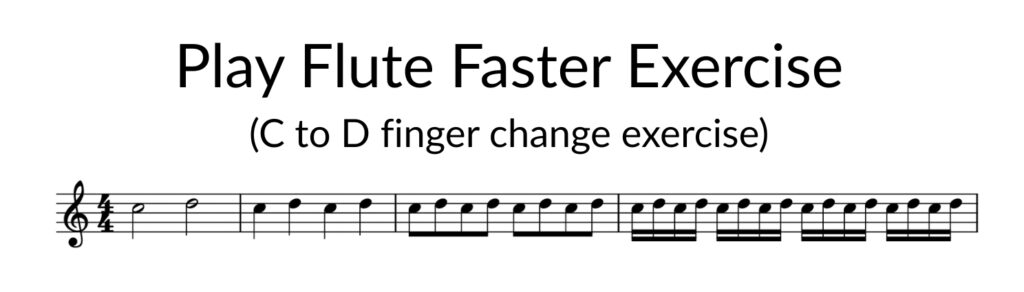
To start practicing this, try playing a simple scale such as C major very slowly, paying close attention to how close your fingers stay to the keys. You can also isolate tricky finger pairs, like C to D, and repeat them until your movements become even and effortless.
Remember, the goal is efficiency first, speed second. As you build this habit, your fingers will naturally speed up without extra strain. Efficiency in your flute playing is often linked with the words “flute technique”.
👉 For quick demonstrations of these exercises, watch the video included on this page. (above)
Building Tonguing Speed
Fingers are only half the equation when you want to play flute faster. The other half is your tongue. Even if your fingers can fly across the keys, your playing will sound uneven and bloppy if your tongue cannot keep up.
We flute players learn to play with single tonguing in the first years, which works fine for slower tempos. But when the music speeds up, single tonguing reaches its limit. That is where double tonguing and triple tonguing come in.
Double tonguing uses two different tongue placements: the front of the tongue (“ta”) and the back of the tongue (“ka”). Practicing this feels like saying “ta-ka, ta-ka.” At first, the “ka” will feel kind of uncoordinated and weaker than the front tongue, but with time, proper exercises and repetition it will even out. I’ll help you out with this inside the module lessons of Learn Flute Online. *Remember that the lessons are in perfect learning order, so you’ll be all set up for this skill when you get to it.
Triple tonguing extends this idea by using certain tongue placements depending on the type of rhythm that needs to be played. This technique is especially helpful in music with fast triplet patterns.
A simple way to begin is to practice these patterns slowly on a single note. Once you feel more comfortable, try using them on scales or short passages. The goal is coordination at first, not just speed. Again, I’ll help you out with this.
Putting Fingers and Tongue Together for More Speed
The magic happens when you combine finger efficiency with tonguing speed. Working on each skill separately is important, but the real breakthrough comes when they begin to sync up. That is when your flute playing can speed up.
Here is how to get started:
- Play a simple scale slowly, keeping your fingers hovering close to the keys.
- Add in double tonguing – start with 4 of each note in the scale.
- Repeat Repeat Repeat: working on synchronizing the two efforts
At first, this may feel awkward, almost like your tongue and fingers are having two different conversations. That is perfectly normal. With steady practice, they will begin to sync up, and you will feel the coordination click into place.
When this happens, speed becomes much easier. Suddenly you are not working harder, but your music flows faster and cleaner. This is the point where many flute players finally feel confident tackling quick passages that once seemed out of reach.

Training Your Brain to Keep Up With Your Fingers and Tongue
There is one more piece to the puzzle of speed that flute players often overlook: mental processing. Even if your fingers are agile and your tongue is coordinated, you can only play flute faster if your brain is prepared to think ahead and send the right instructions in time.
When you play music, your mind is constantly translating notes on the page into finger movements, breath control, and tonguing patterns. If your brain gets behind, the result is hesitation, stumbles, or even freezing up in the middle of a passage. This is why developing “thinking speed” is just as important as physical speed.
Here are a few ways to strengthen your mental processing for fast playing:
- Chunk the music. Instead of seeing individual notes, train yourself to recognize groups of notes (like scales, arpeggios, or common patterns). Your brain processes chunks much faster than single bits.
- Look ahead. Practice scanning one or two beats beyond where you are currently playing. This gives your mind time to prepare your fingers and tongue.
- Use a metronome. Start slow and gradually increase the tempo. Your brain learns to anticipate rhythm and timing, which sharpens your overall processing speed.
- Sing or say the rhythm first. If you can process it with your voice, your brain will more easily send the right signals to your fingers and tongue.
Remember, your brain is like a conductor leading the orchestra. If the conductor is confident and ahead of the music, the whole ensemble plays beautifully together. When your mental processing, finger technique, and tonguing speed are all aligned, you will be amazed at how naturally your flute speed improves.
A Daily Practice Routine to Play Flute Faster
Learning to play flute faster is not about cramming as many notes as possible into your practice time. It is about working step by step on the skills that build speed naturally. With just ten to fifteen minutes of focused work each day, you can make steady progress.
Here is a sample routine you can try:
- Warm up with a simple scale (2 minutes).
Choose C major or another easy scale. Play slowly, keeping your fingers close to the keys. Focus on relaxed hand position and smooth air flow. Really focus on this – you can do it! - Finger hover drill (2 minutes).
Pick two notes that are tricky for you, such as C to D or D to E. Play them back and forth slowly, keeping your fingers low and controlled. Repeat until the motion feels light and easy. - Double or triple tonguing exercise (3 minutes).
Stay on a single note and practice double tonguing. Use 4 of each note to start with. Focus on front tongue and then back tongue. Forward, Back, Forward, Back. Use a metronome to keep it even. Your notes won’t sound as clear as they usually do during these first months of learning to double tongue.. Don’t worry about it so much. Just learn the movement and work on processing what is supposed to happen. - Combine fingers and tongue (3 minutes).
Play a scale or short passage, adding your double tonguing. Keep the tempo slow enough that your fingers and tongue stay coordinated. Gradually increase speed as it feels comfortable… and as long as you’re keeping up. - Mental processing drill (2–3 minutes).
Look ahead in your music while playing, scanning a beat or two in advance. If you prefer, clap or say the rhythm of a passage before playing it to train your brain to stay ahead. *Familiarity is a HUGE key to being able to play with speed, so study your music well.
This short routine will help you train every part of your flute speed system: fingers, tongue, and brain. With regular practice, you will notice that passages which once felt impossible start to flow faster and faster each month.
Conclusion
Speed on the flute is not something that appears overnight. It is built step by step as you learn how to move your fingers efficiently, coordinate your tonguing, and train your brain to process the music quickly. By keeping your fingers close to the keys, practicing double and triple tonguing, and working through a focused routine, you will find yourself able to play flute faster with more ease and confidence.
As you keep building these habits, your flute playing will feel more proficient and more enjoyable every single day.
And if you are ready to go further and deeper (and have even more fun!), come join us inside the Learn Flute Online members area. That is where all the lessons, exercises, and step-by-step training are waiting for you. The level order here is: Silver (novice), Gold (Foundational), Intermediate, Advanced. Everything is organized to help you progress quickly, enjoy your flute journey, and truly love the way you play and sound.
Let me know if you have any comments or questions – I’m here for you! – Rebecca