

Top 3 Flute Techniques for Beginners: Step-by-Step Flute Success
Learning the flute is a journey filled with excitement, challenges, and the joy of creating beautiful music. If you’re a beginner, it’s easy to feel overwhelmed by the many skills and flute techniques you need to develop, from holding the instrument correctly to producing your first clear note (and yes, you can do it!).
But here’s the good news: you don’t have to learn everything at once, and you certainly don’t need to struggle through guesswork. By focusing on the right flute techniques for beginners, you can fast-track your progress, reduce frustration, and find more joy in playing from day one.
This guide will walk you through the top 3 flute techniques for beginners that form the foundation of your flute-playing journey: using your breath, embouchure development, and balancing the instrument with coordination. These three pillars are essential for building good habits that last a lifetime.
Remember, every flutist started as a beginner flute player, and with consistent, mindful practice, you’ll soon see your skills soar.
If you’re ready for a structured, proven way to keep improving your flute techniques, come and join Learn Flute Online. Our members’ area includes comprehensive lessons, sheet music, video tutorials (pre-recorded so you can move along quickly), and support to guide you every step of the way.
Now, let’s take a deep dive into these flute techniques that will speed up your flute learning journey and set you up for success!
Step 1: Mastering Proper Breath Control : The Essential Flute Technique for Beginners
Why Breath Control is the Foundation of Great Flute Playing
Flute playing is unique because your breath is literally your instrument’s engine. Learning to use your breath to create a note is kind of an unusual request. Pianists and string players, for example, never have to think about these things.
Learning to use your breath and how to control it is one of the most essential flute techniques for producing a consistent tone.
Research from McGill University highlights diaphragmatic (belly) breathing as the most efficient way to produce a steady airflow. This deep breathing method helps sustain longer phrases, produce a fuller tone, and reduces tension in your neck and shoulders, common problems that interfere with clean sound production.
For beginner flute players, mastering breath control is often the biggest hurdle. Many new players blow too hard or breathe too shallowly, resulting in squeaks, weak tones, or super short phrases. Learning how to manage your breath is the first major skill that accelerates your progress… but it doesn’t happen without knowing and understanding the combination of embouchure, aperture, breath, and instrument knowledge.
–
The Physiology of Breathing for Flute Players
No matter the age a flute player is, they can always work on better flute technique. Learning how to manage our airstream (breath) is a really big deal.. So let’s get started!
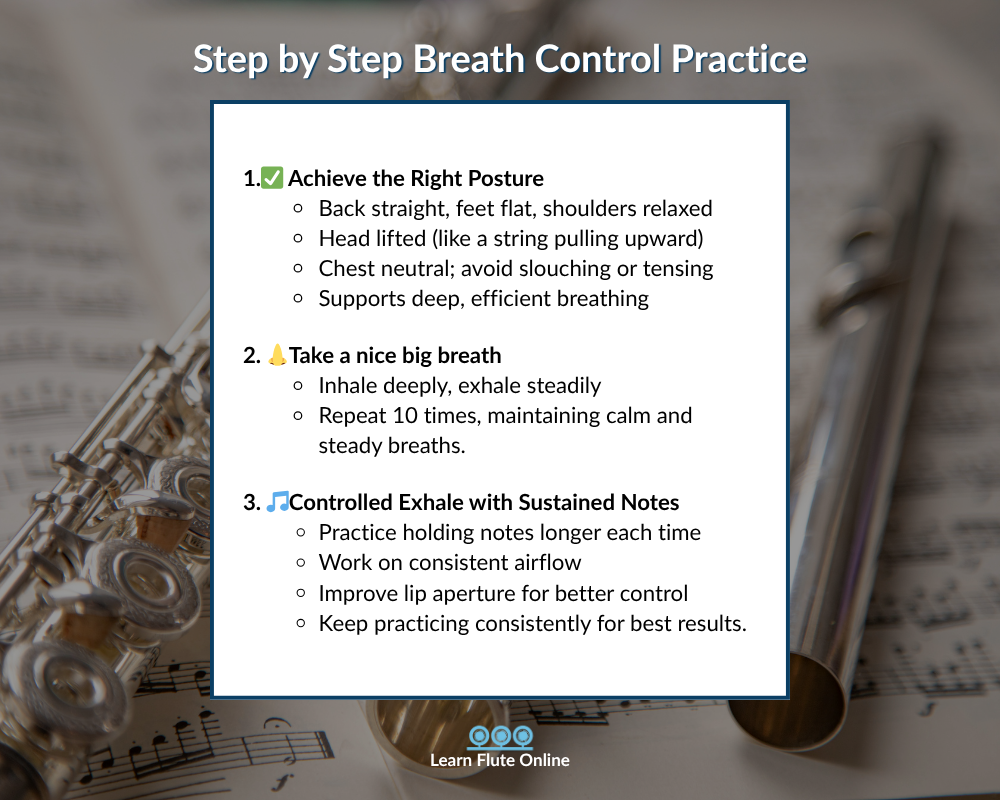
Step by Step Breath Control Practice
Step 1: Achieve the Right Posture
Keeping your body in good, neutral position (back straight, feet flat on the floor, and shoulders relaxed) really helps get a player ready to breathe and play the flute with efficiency.
Imagine a string pulling the top of your head upwards to elongate your spine.
Keep your chest neutral, not puffed out or sagging.
Avoid slouching, leaning forward, or tensing your neck and shoulders.
Good posture supports deep breathing and prevents fatigue (for flute players especially!).
Step 2: Take a nice big breath
Look in a mirror. What do your different body parts do while you breathe in and out deeply?
You may find it interesting that while ‘they’ say it takes a ton of breath to play the flute, it’s actually more about breath efficiency. How we shape our airstream in combination with the function of the ‘what’s inside our mouth and body’ is what makes us sound amazingly great.
Learn to inhale and then exhale fully in a nice steady, strong stream of air.
Repeat this 10 times, aiming for calm, steady breaths.
Practice this daily in the first week especially to build lung capacity and breathing awareness.
Step 3: Controlled Exhale with Sustained Notes
Beginner flute players usually have a hard time holding their notes very long. Usually they say “I can’t seem to hold my breath”. What they mean is that their airstream doesn’t seem to last as long as they want to before running out.
Work on varying lengths of notes in the first weeks and months is a really good idea.
Try to increase your longer notes with each practice session.
Note: as you learn to focus the hole in your lips (aperture), you’ll find that your breath control gets better and better. Keep working on it!
Common Breath Control Challenges and Fixes
Do you find you make a lot of squeaks?
Squeaky sound: If you’re a newer flute players, this is often caused by blowing too hard for the position your lip plate is it.. Basically, we have to learn to regulate how much air goes into the flute and how much goes over the top of the lip plate. (this is how we create our tones on the flute)
Tip: Watch out for tension in neck, throat, and shoulders: Relax and reset posture regularly during practice.
Bonus Breath Control Tips
Practice breathing exercises before playing your flute to warm up making sure you aren’t contorting or doing anything that doesn’t feel natural to your body.
Use a mirror or video to check for these posture and body tension signs.
Incorporate breath control into your warm-ups for long-term improvement. (I’ll teach you more inside Learn Flute Online’s members area)
This blog (Learn Flute Online Articles and Knowledge Base) is a great resource for learning more about optimizing breathing as you try to progress as a flute player. Be sure to check out even more flute playing articles often.
There are many flute techniques to learn. Be patient and continue the journey.
Step 2: Developing a Strong and Flexible Embouchure : A Core Flute Technique for Beautiful Tone
Understanding Embouchure: What is it and how do you use it to play the flute?
Think of it this way: Your embouchure includes all of your face and any muscles used to shape your lips etc. Your embouchure controls the shape and direction of the airstream that produces sound on the flute. A relaxed embouchure is one of the most important flute techniques to strive for that affects tone quality.
Beginner flute players need time to develop their embouchure and their aperture (the hole in the lips and the muscles that help shape it). Many new flutists struggle with airy or unstable tones due to an unformed embouchure. Aka: their hole in their lips is too big at first.
Step by Step Guide to Embouchure Formation
Step 1: Relax Your Facial Muscles
Pretend you’re sleeping. Exhale slightly allowing your lips to naturally part in the middle. This is considered a really nice embouchure – very relaxed. Keep your lips soft but firm enough to control the airflow.
Relax your jaw to prevent unnecessary tension.
Step 2: Find the Aperture
The aperture is the small opening between your lips through which air flows.
Aim for a narrow, controlled opening about the size of a pen tip.
Practice blowing this steady air stream onto your hand or a mirror.
Step 3: Positioning the Flute Correctly
Place the flute’s lip plate gently against your bottom lip.
Your bottom lip should overhang a slight bit to cover approximately one-quarter of the embouchure hole.
Your upper lip needs to be careful not to tip down covering the hole more than it should.
Step 4: Sound Production
Blow across the hole at a slight downward angle.
Adjust the lip shape and air direction until you hear a clear, focused tone.
Experiment with subtle changes to find your best sound.
*This takes a while. I’ll help guide you to a nice flute embouchure, no worries.
More Embouchure Tips for Control and Flexibility
Although you may hear phrases like “develop your embouchure” and “tighten your embouchure” or “strengthen your embouchure”, these phrases are actually opposite of what you want to do when learning to play and progress on the flute.
Staying relaxed and learning to shape your embouchure and aperture is key to having beautiful, controlled, resonant tone.
Learning to use special warm-ups for your flute practice day can really help you get started right.
Common Embouchure Mistakes and How to Fix Them
Flute pressed too hard: Causes tension and muffled tone. Hold the flute very lightly against your lips.
Too wide an aperture: Leads to airy, unfocused sound. Close the opening by simply closing the lips… this is especially good to focus on within your first year of playing. Remember that closing it too small and pinching the face muscles leads to a pinchy, tight sound.
Flute players who learn by themselves or in a band situation (with a teacher who hasn’t studied flute techniques and pedagogy) won’t realize how important these flute techniques are to learn. I 100% understand this, and am here for you.
Step 3: Mastering Finger Placement and Coordination : Vital Flute Techniques for Smooth Playing
Why Finger Technique Matters from the Start
Finger movement and coordination are often overlooked, and they’re critical flute techniques that influence your ability to play smoothly and accurately. Getting this right early on sets you up for faster learning and better expression.
Working on proper balance of the flute and finger agility (moving easily between the different finger patterns) early helps set the tone for really fluid flute playing.
Flute Techniques: Finger Placement and Movement
Step 1: Learn Your Fingering Chart
Begin with the basic fingering positions for notes like B, A, G, C, D, and E.
You can find the perfect learning sequence taught inside the module lessons of Learn Flute Online. (many fingering charts are flawed online – I have the best ones)
Step 2: Practice Slow, Precise Finger Changes
Place your fingers on the keys lightly but firmly.
Relax each finger (the keys of your flute will raise your fingers for you) and replace them carefully, over and over for practice.
I remember learning (in my flute pedagogy studies) that flute techniques to do with fingers and hand positions are very important, and nothing I had ever heard about before then. My fingers became more relaxed and I definitely sped up after this.
Tip: Make sure you press the keys right in the center of the key – this will keep your instrument in good condition over time especially.
Step 3: Finger Coordination with Breath and Embouchure
Practice simple scales, focusing on matching finger movements with breath control and embouchure.
Aim for smooth, quiet finger transitions.
Tip: think of moving your fingers to the new positions between the notes.
Step 4: Introduce a Metronome
Maintaining accuracy and evenness when playing music is actually a big deal to sounding amazing on your instrument. Flute techniques can be learned really well by becoming friends with your metronome.
Finger Exercises for Beginners
Five-Finger Scale: Play notes up and down the scale slowly and evenly.
Start with the easiest ones like: F G A Bb C – work on this ascending and descending both until super easy. (many repetitions = muscle memory)
Tips to Improve Finger Speed and Accuracy
Keep fingers closer to the keys to reduce unnecessary movement.
Relax your hands and wrists; tension slows you down.
Use short practice sessions – 5 minutes is okay for the different flute techniques practice sessions.
Common Finger Technique Issues and Solutions
Slow finger response: Practice slow, focused exercises with a metronome once you get to that point.
If you’re ready for a structured, proven way to keep improving on your flute, come and join Learn Flute Online. In our flutie community and the members’ area, you’ll have access to my full learning path with videos, audios, sheet music, and personalized support to keep you motivated and progressing fast.
Additional Tips for Beginner Flutists
Incorporating these flute techniques into a daily routine will make your progress steady and noticeable. Make time each day to revisit breath control, embouchure, and finger exercises.
Consistency beats intensity. It’s better to practice 15 minutes daily than 2 hours once a week. Break your session into warm-up, technique drills, and song practice.
Celebrate small wins to stay motivated, and remember that I have your back. The members area here at Learn Flute Online has everything you need to get and keep going.
Historical Context and Fun Facts About Flute Playing
The flute is one of the oldest musical instruments in human history, dating back over 35,000 years. Early flutes were made from bone and wood, evolving over centuries to the modern metal concert flute.
Nowadays, we have modern inventions for the flute, better materials and workmanship, and more opportunities than ever to play and enjoy music and this instrument.
Knowing the flute’s rich history can deepen your appreciation and inspire your practice. Let’s continue learning!
Frequently Asked Questions (FAQ)
Q1: How long does it take to learn the flute as a beginner?
A: Most beginners start playing simple songs within a few weeks. Mastery takes years, but consistent practice speeds progress.
Q2: Can I teach myself flute, or do I need a teacher?
A: Self-teaching is very possible with really good resources like the members area of Learn Flute Online. (tooting my own horn here)
Q3: How often should I practice?
A: Aim for daily practice, even just 15–30 minutes. Consistency is key.
Q4: Why do I get squeaky sounds sometimes?
A: Usually due to improper breath direction or embouchure shape. Slow down and experiment with air angle. Remember when I mentioned that balance of the flute is important? Yep- this will keep you from squeaking and ensure you learn to play with a relaxed embouchure.
Q5: What’s the best way to improve finger speed?
A: Use slow scales with a metronome if possible, gradually increasing tempo while maintaining accuracy. The only way to speed up is to improve finger technique and small steps that bring more speed into your playing.
Conclusion
Mastering the flute as a beginner is an exciting adventure built on the pillars of breath control, embouchure development, and finger technique. By focusing on these essential flute techniques and practicing them mindfully every day, you’ll build a strong foundation for beautiful music-making.
Remember, every note you play brings you closer to your musical goals. Stay patient, enjoy the process, and use reliable resources like Learn Flute Online to guide you.
Now it’s your turn! Pick up your flute, start with the breath exercises, and watch your flute techniques and overall playing skills soar.
Warm wishes,
Rebecca
Learn Flute Online