

Create Your Perfect Flute Practice Routine: Steps to Sound Better Every Day
Welcome! If you are looking to build a flute practice routine that truly helps you sound better every day, you are in the right place. In this article, I will guide you through creating a nice, general daily practice plan that feels structured, clear, and enjoyable.
A well-designed flute practice routine is one of the most important keys to real improvement. Having a plan helps you stay motivated, build strong habits, and avoid the frustration that comes from not knowing what to work on next.
By following a thoughtful flute practice routine, you can improve your flute tone, strengthen your technique, and gain more confidence in your playing.
The best part is that this approach works for everyone. Whether you are a complete beginner learning your first notes or an advanced player refining your sound, having a daily practice plan will support your goals and keep you excited to pick up your flute.
Let’s get started and create a flute practice routine that helps you enjoy your progress and grow as a flutist every single day.
The Power of Warm-Ups
When I first started learning the flute, most of my early teachers were general band directors who did not actually play the flute themselves. Later, I worked with a private teacher who loved music (fabulous flute player), but didn’t seem to have a clear plan for my progress.
I remember feeling a bit lost, no clue on how to practice, memorize, perform etc. and I was constantly wondering if I was moving forward or just plowing through the ‘books’ without aim.
Everything changed when I arrived at a large music school at the university level. Surrounded by talented musicians and guided by experienced flute professors, I quickly realized that the true path to improvement is exactly that… a path. Having a real, step-by-step plan made all the difference in my growth and confidence as a musician.
I want to help you find that same clear direction. One of the most important places to start is with warm-ups. The first thing I learned at the University level was that the warm-ups were the most important part of the lesson.
A good warm-up is not just about getting your fingers and lips moving. It sets the tone for your entire practice session, both physically and mentally. By focusing on warm-ups first, you prepare your body for healthy playing and build a strong foundation for tone and technique.
Learning how to focus on real techniques that make a difference in tone was very eye-opening for me. I felt like I was on cloud 9 as I played them… because I was changing and evolving into who I wanted to be – it was like heaven to me. (I’m actually not exaggerating)
One of the most effective warm-up exercises for a flute practice routine is playing long tones. Let me guide you through a simple example of this so you can get started:
Choose a comfortable note, like a low B, and hold it steadily while listening closely for clarity and richness. After each note, take the flute off your face, reset, and try again. Think about relaxing your embouchure and creating more space inside your mouth for resonance. Each repetition gives you a chance to refine and improve.
When you focus on these small details during warm-ups, you create habits that support your entire flute practice routine. Over time, your tone will become more stable, richer and beautiful, and you will feel more control over your sound.
Tip: be honest with yourself. Are you adding in all the skills you have learned? Analyze your sound. Find descriptive words for what you hear – these will be clues you can use to improve. (example: gravelly, dry, or wobbly)
Warm-ups might sound slow and simple, but they are one of the most powerful tools you have as a flutist. With patience and careful listening, you will start each practice session with focus and intention, ready to make real progress.
Mastering Scales and Arpeggios
After warming up your tone (waking up your face), and getting your air flowing, it is time to focus on scales and arpeggios. These might seem basic, but they are the building blocks of almost everything you will play on the flute.
Practicing scales is one of the best ways to develop finger dexterity and improve your ear training. Basically, scales will help you get familiar with the flute. We need A LOT of muscle memory to be quick and efficient.
By moving through different key signatures (I’ll show you, don’t worry), you teach your fingers to move smoothly and evenly, which helps you play faster passages later on.
We really do need muscle memory for all of the finger combinations. Mastering these in a scale setting, allows us to sail through every piece of music later on. (trust me)
A helpful tool during scale practice is your metronome. A metronome is that device that clicks (nonstop haha) at you.. And is more important than you might think.
We often think we are able to naturally keep a steady tempo, but in reality, our sense of timing often drifts without a clear guide. Using a metronome helps you stay honest and consistent. Start slowly, making sure every note is clear and even, then gradually increase the speed as you gain control.
If you haven’t used a metronome before, here’s a quick starting point: set the click at a number (bpm=beats per minute) and attempt to play one short note (any note) at the exact precise time you hear the click. Get really good at this at different tempos.

The trick is to learn to change your fingers to the new position simultaneously and land the sound of it at the exact moment in time it’s supposed to be on (hence the need for the aid of a metronome)
Starting out slowly and listening for awkward note changing noises is a good way to improve quickly. Just being aware of what’s happening is a really big deal to your progress.
Practicing different articulations within your scales and arpeggios adds another valuable layer to your flute practice routine. Basically, if you’re feeling bored with your scales it’s time to add articulation patterns.
Try playing one scale slurred all the way through, then repeat it tongued on each note. Work through different skills like legato, staccato, and then alternate. You can also experiment with accented notes or different rhythmic patterns.
These variations build control and prepare you for all the different styles you will encounter in real music. ..and by the way, these patterns are used waaaay up into the very advanced level. Never a dull moment when you change up the articulation and add more speed!

Including scales and arpeggios in your daily practice might not feel flashy, but they will transform your playing from the inside out. Over time, you will notice more confidence in your technique and a stronger, more even sound across all your music.
My opinion: Scales are always a fun challenge that only take up a short part of your flute practice routine, but pack a big punch for your future.
Strengthening Note Reading with Exercises and Etudes
Once you have built a strong foundation with warm-ups and scales, it is time to connect your technique to real music. This is where note reading exercises and etudes come into play. These pieces act as a bridge between technical drills and full songs, helping you apply your skills in a musical context. (Win-Win!)
When you start a new piece or etude, it can feel overwhelming to look at all the notes at once. Some people say that they feel scared when they see all the ‘black’ on the page haha.
One of the best strategies is to break the music into small sections. Instead of trying to play from the first note to the last in one go, focus on just one or two lines at a time. This makes the task more manageable and allows you to focus on the details that matter most.
Looping tricky spots is another powerful technique to build confidence. If you find a measure or two that is difficult, isolate it and play it slowly, many times in a row. As you become more comfortable, you can gradually add the surrounding notes and blend it back into the full piece. This approach helps you master the hardest parts without becoming frustrated or losing motivation.
**Accuracy should always come before speed. **
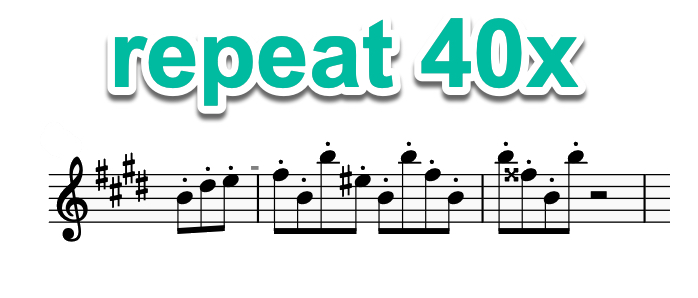
It can be tempting to rush through pieces to hear the whole song, but playing too quickly too soon often leads to sloppy habits. Take your time during your flute practice routine especially to make sure every note is correct and that the rhythm as notate on the page is 100% correct. Once you feel secure, you can start to build up speed little by little (even if it’s after 14 practice sessions, that’s okay and normal)
Practicing etudes and note reading exercises regularly will strengthen your reading skills and improve your overall musicianship. You will become more confident in tackling new music and feel proud of how your technical work supports your overall goals as a budding musician. (basically, you’re going to get really good.. So look forward to it!)
Expressive Tunes and Solos
After working on warm-ups, scales, and etudes, it is time for the most rewarding part of your flute practice routine: playing actual music. (the part you probably like the most!)
This is where all your hard work comes together and you get to enjoy making beautiful sounds.. And get to play music that makes your soul sing!
When you move into your tunes, solos, or favorite melodies, focus on adding musicality and expression. This means thinking beyond just the notes on the page. Pay attention to phrasing, dynamics, and the emotional story you want to tell through your playing. For example, if you’re playing a melody that was actually a song you know (like with someone singing), imagine singing the phrases in your mind before you play it. This helps you shape the music in a more natural and expressive way. The words you’re used to singing will be your clue to how long you should hold each note etc. no matter how it’s written on the staff.

A common area many flutists overlook is how they end their phrases. Instead of letting the sound “splat” or drop off suddenly, think about finishing each phrase delicately, as if you are carefully placing the last word of a sentence. This is easier said than done though if you haven’t learned yet.
Learning to ‘taper’ or ‘fade’ is a super duper big deal in the flute world. I can’t wait to show you! This is an example of what is in the member modules inside Learn Flute Online (something to look forward to!) The difference is often dramatic and makes your playing sound much more professional and polished. (keep this in your flute practice routine)
Adding style and personality to your playing is what makes your music truly enjoyable. Imagine telling a story each time you play a piece. What feeling do you want to share? Where should it feel strong, and where should it feel soft and tender?
Ending your practice session with the thought of “I’ve done what I can for today.. That was really fun.. I Can’t wait to try again tomorrow” is a perfect headspace to be in. (and congrats!)
Conclusion: The Secret Ingredient and Your Next Steps
One of the most important parts of a successful flute practice routine is consistency.
Practicing a little bit every day is far more effective than long, infrequent sessions. (true!) Even starting with just 20 to 30 minutes a day can create real, noticeable progress. As you build stamina and skill, you might even enjoy adding a second short session to your day. The key is to make practice a regular part of your life so it becomes a joyful habit rather than a chore.
PRO TIPS: Overuse injuries are real. If you’re new, keep practices short and within your ability level so your muscles stay healthy. Learn real technical skills so you will be on the up and up always. Raise your level gradually and keep your endorphins high so you’ll be able to play forever. 🙂
Acknowledging little victories will keep you motivated and excited to continue.
Having clear guidance and structured lessons can make an incredible difference in your journey. Inside Learn Flute Online, I have designed lesson modules for every step of every level. (True)
We have the Gold Level for beginners and the foundational level, the Intermediate Level, and the Advanced Level for those ready to take things even further. These step-by-step flute lessons are organized so you always know exactly what to work on next, which helps you build skills with confidence and enjoy your progress.
The flexibility to learn at your own pace and the support from a warm, welcoming community means you can move forward without feeling alone. You will always have encouragement and clear instructions to help you grow into the flutist you dream of becoming.
As you finish reading this today, I encourage you to think about what part of your practice routine you enjoy the most. Which section makes you feel the most inspired? I would love to hear your thoughts, so feel free to share in the comments below.
If you are ready to take your flute playing to the next level and truly love the way you sound, I invite you to explore Learn Flute Online (if you’re not inside already). You will find detailed, step-by-step lessons designed to help you succeed and enjoy every moment of your musical journey.
Enjoy!
Rebecca